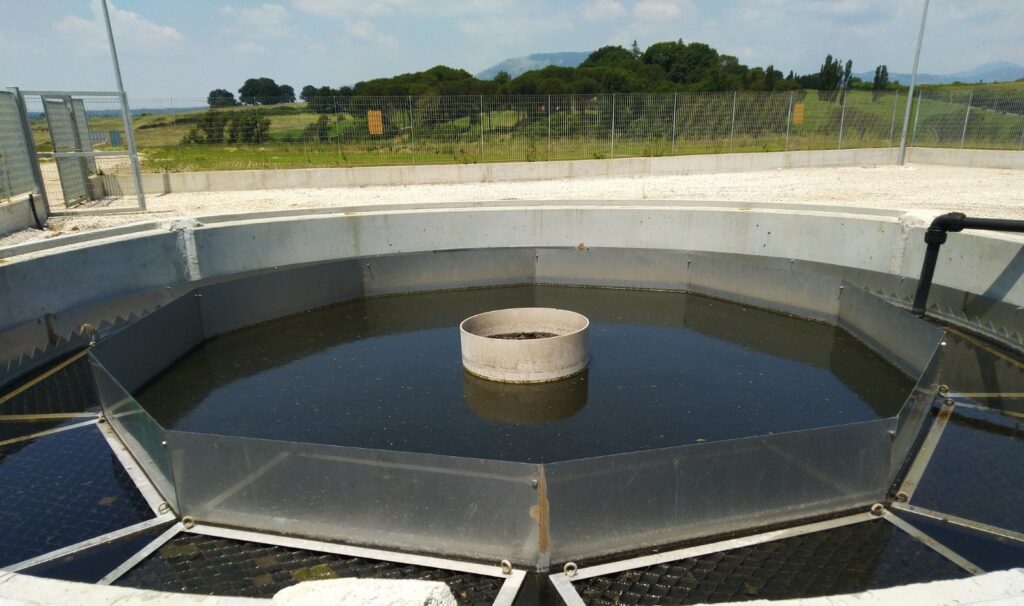
The operation of activated sludge systems is based on the oxidation process: by providing and diffusing intensive and prolonged oxygenation, bacterial colonies are activated within the sewage. By combining with the organic matter they feed on, these colonies aggregate into flocs, degrading the organic matter into smaller and less hazardous compounds (which are partly reused by the microorganisms themselves for nourishment and reproduction). The activated sludge flocs can subsequently be settled, thereby discharging the clarified effluent.
SBR reactors are simple in terms of construction and management, possess the capacity to equalize peak loads, offer operational flexibility, do not require sludge recirculation, and allow for the selection of floc-forming bacteria thanks to the alternating process conditions.
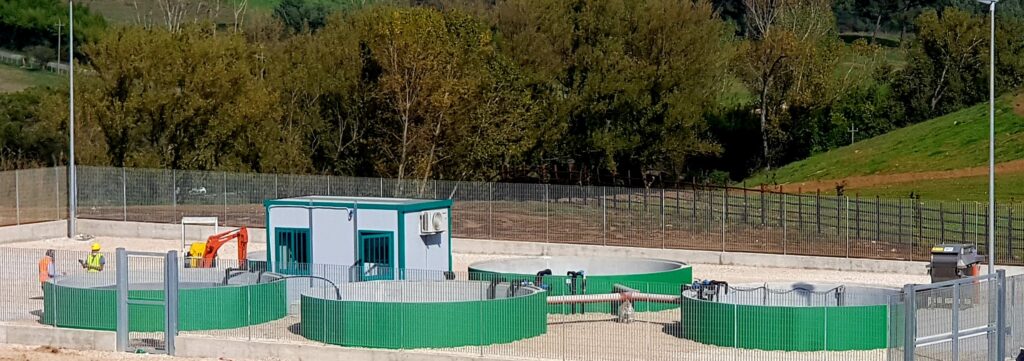
Unlike traditional activated sludge processes, SBR systems are fed discontinuously and have an operating cycle that includes a charging phase, one or more reaction phases (aerobic, anoxic, or anaerobic), a sludge sedimentation phase, an effluent discharge phase, an excess sludge wasting phase, and an idle phase. The phases of the SBR operating cycle can be controlled with level sensors and/or timers. The system will be designed modularly, so that one part can be used solely for the grape harvest period and another part for the remainder of the year; furthermore, it is possible to initially implement the system volume required for current production loads, with plans to add similar units in parallel at a later stage to cope with any production increases.
If the discharge objectives involve discharge onto the soil or the reuse of treated wastewater, the options include the adoption of attached biomass systems, such as one or more stages in series of vertical sub-surface flow phytodepuration. This allows for the achievement of the highest purification standards and constitutes a sort of safeguard barrier (or “buffer”) against any operational anomalies of the SBR system, which can be utilized during extraordinary maintenance operations of the electromechanical parts present in the SBR.
MBR systems, on the other hand, utilize much more advanced technological equipment (ultrafiltration), the peculiarities of which allow for an effluent completely free of any pollutants. These are intensive systems that involve reduced footprints compared to other biological treatment techniques; in addition to having installation costs appropriate to the degree of technical complexity, management costs are expected in terms of specialized technicians and mandatory maintenance operations (cartridge washing, etc.).
MBBR systems are based on a moving bed biological process (Moving Bed Biofilm Reactor, hence the acronym MBBR by which they are commonly known). They consist of tanks partially filled with inert polyethylene supports (“carriers”), kept in motion by appropriate mixing and/or aeration systems. The surface of the supports is colonized by an active biological film, entirely similar to that of biofilters. The mechanical separation between the treated effluent and the excess sloughed biomass occurs in a subsequent treatment phase.
*The MBBR system is a biological system with high organic load removal efficiency, combining the advantages of classic activated sludge systems with suspended biomass and those of attached biomass systems (cultures fixed on an inert support material). From the perspective of the space required for installation, the MBBR solution allows for a higher concentration of microorganisms than is usual for classic activated sludge treatments, and therefore a proportional reduction in footprint.