
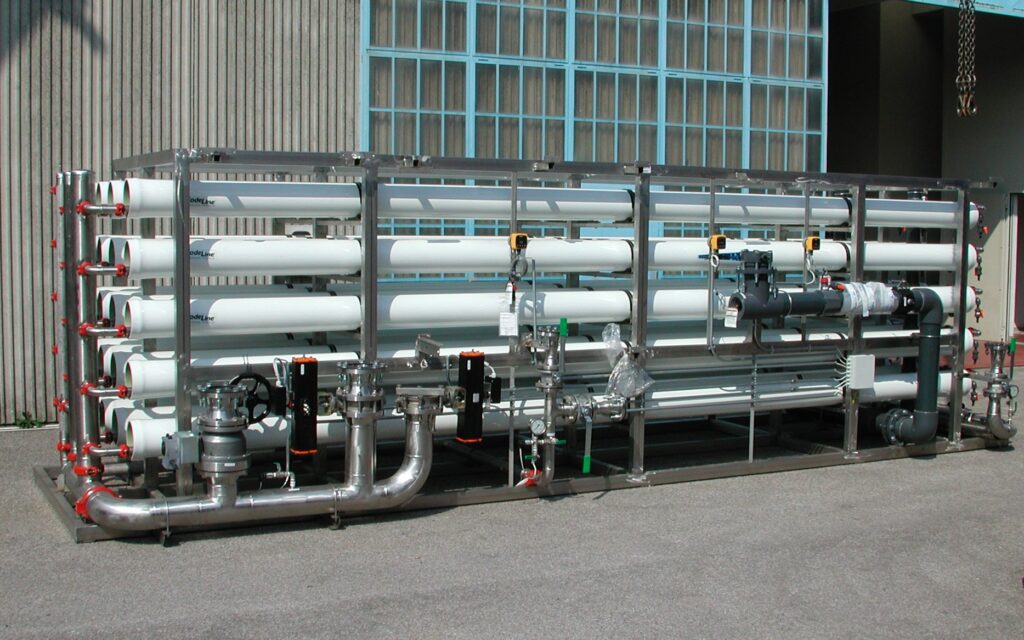
REVERSE OSMOSIS
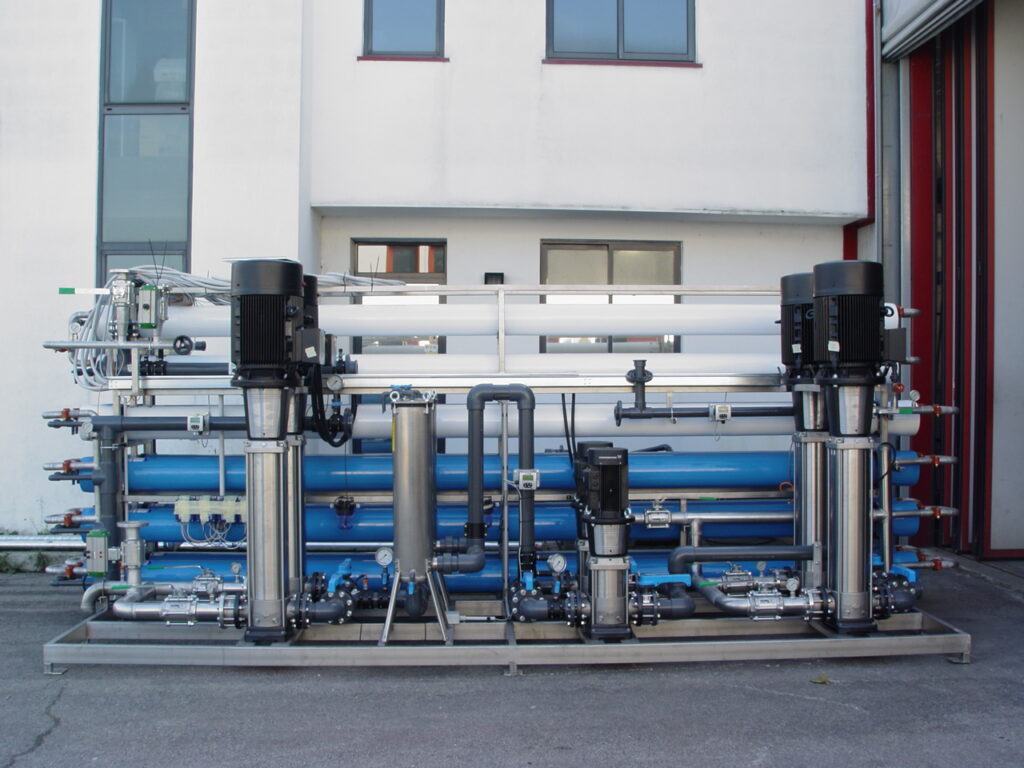
NANOFILTRATION
“Reverse” Osmosis is the process that occurs when a saline solution is brought into contact with a water-permeable membrane (not permeable to dissolved solids) at a pressure higher than the osmotic pressure of the solution itself.
It is the opposite process of “direct” osmosis, which occurs naturally in the absence of external pressures on the system. When two solutions at different concentrations, contained in two separate containers, are brought into contact through a semipermeable membrane, a flow occurs from the lower concentration solution toward the higher concentration solution, resulting in a decrease in concentration in the latter.
Through the membrane, a solution (permeate) with a lower salt content than the starting solution passes, while outside the membrane a salt-rich solution (concentrate) is formed.
This process represents the finest water filtration technique: a technique that, to date, constitutes the most convenient and safe method for demineralizing water from various sources, progressively replacing other treatment systems, thanks to the excellent combination of outstanding results and contained operating costs (reverse osmosis systems guarantee low energy consumption and limited chemical product consumption). Furthermore, the parameters of the waste water generally fall within the discharge limits, thus reducing the increasingly pressing problem of eluate disposal (a problem that exists, for example, with water softeners and ion exchange resin demineralizers).
To correctly design a reverse osmosis process, it is important to determine the most suitable “pre-treatment” based on the characteristics of the water to be treated in order to ensure greater operational continuity of the system and reduce the frequency of cleaning. Proper pre-treatment prevents rapid membrane clogging due to dirt and/or physical impurities, clogging due to precipitation of scaling salts and/or metals, bacterial proliferation, and contact with oxidizing agents.
In the reverse osmosis process, semipermeable membranes composed of thin films (TFC or TFM, Thin Film Composite Membrane) are used.

