
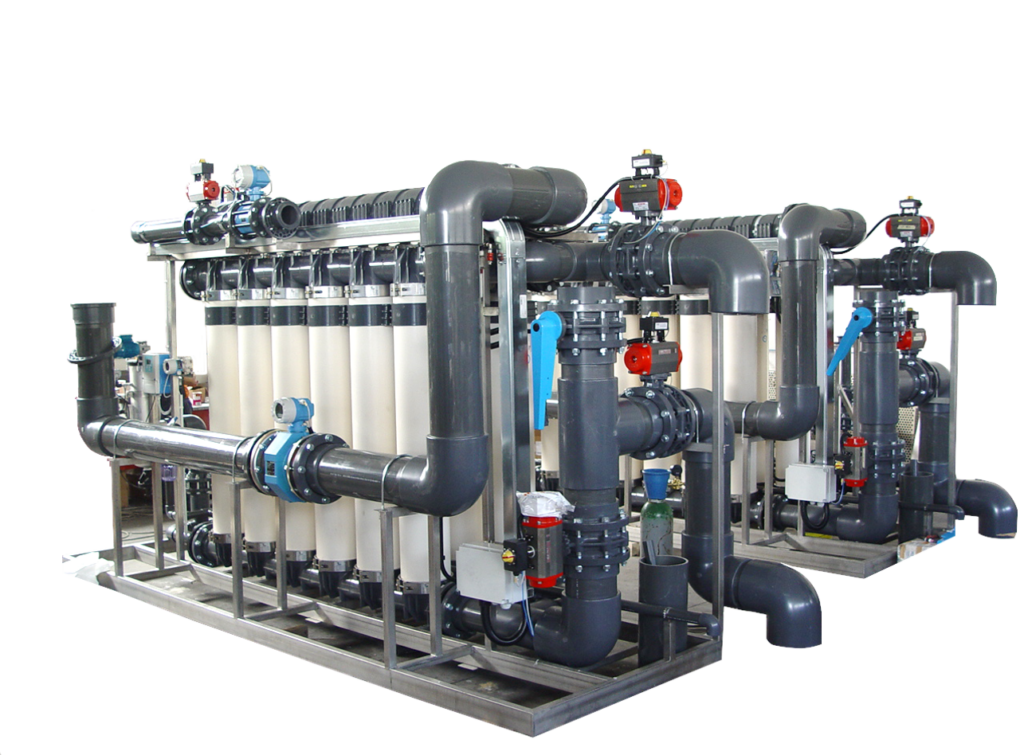
ULTRAFILTRATION
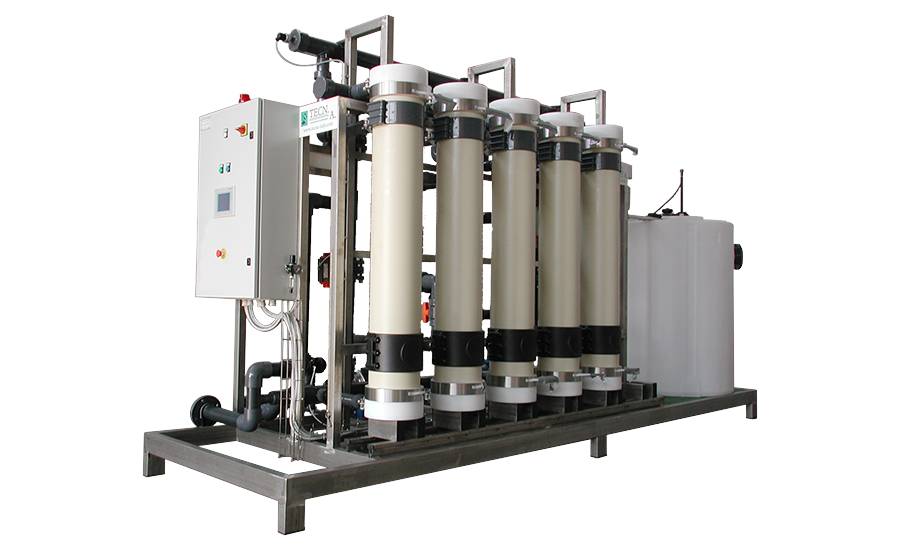
Membrane filtration is a process that allows for the separation of various substances from water through the use of a semi-permeable membrane.
The membrane (generally hollow fiber outside-in or inside-out) is capable of treating flows from various sources and can remove suspended solids, colloids, and all types of microorganisms such as bacteria, viruses, protozoa, germs, and larvae.
The separation process occurs by applying a pressure differential that allows for the separation of
particulate matter from the soluble component in the fluid, applying a transmembrane pressure ranging between 0.5 and 5 bar. The membranes generally have a pore size between 0.01 and 0.10 μm.
Compared to conventional water treatment systems, ultrafiltration technology offers
several advantages:
– the quality of the permeate does not depend on the feed water to the plant;
– it provides a barrier against bacteria and particles in general;
– it allows for the elimination of any pathogens that are resistant to chlorination;
– The concentrate originating from the ultrafiltration process is composed of water contaminants. The quantity produced for disposal is significantly lower than that of sludge from conventional treatments;
– the possibility of designing compact systems allows for limited investment in structures and requires
limited space for the installation of the systems themselves.
Ultrafiltration membranes can be produced essentially in two types (tubular or flat) and are normally manufactured on a porous substrate. The single operating unit based on which ultrafiltration systems are designed is called a module. Each operating module consists of membranes, support structures, feed water, concentrate discharge, and permeate outlet.

